Heroism of the Redemptorist martyrs during socialist persecution
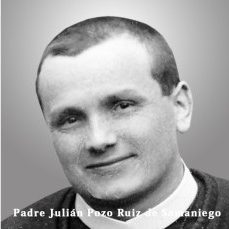
Blessed Father Julián Pozo Ruiz de Samaniego, C.Ss.R
(1903-1936)
https://testigosdelaredencion.blogspot.com/2011/04/julian-pozo-ruiz-de-samaniego.html
https://www.redemptorists.co.uk/news-and-events/news-items/733-new-cssr-beati.html

Eclipse of faith? Western society dying? Is there, in the lives of the martyrs, a lesson to be drawn for our woke time, when the Church shaped by Second Vatican Council prevails?
3 examples of healthy communication:
- the fair analysis by Padre Jaime Mercant Simó
- a letter from Bishop Joseph Strickland
- the interview of Bishop Schneider
+
Jaime Mercant Simó, Diocesan Priest and CETEM Professor: “The Excommunication of Msgr. Lefebvre is Null. Consecrations in 2026? Neither Schism nor Sin” (Q&A in 23 Points)
23 Febbraio 2026 | Attualità, Vaticano II e crisi nella Chiesa
First of all, let us clarify: Don Jaime Mercant Simó is not “Lefebvrian,” but a diocesan priest with several doctorates, a professor at the Center for Theological Studies, and director of the library of his diocese (Majorca). His extensive biography is attached at the bottom*. Although we do not individually share every passage of his declaration (shared on X), we report it below as it is useful for clearing the field of much nonsense circulated in recent days.
Furthermore, here are some references for broader materials: on the theme of obedience, [see] this article; on the theme of the nullity of the 1988 excommunication, see this study by Prof. Pasqualucci. Finally, as always, to understand the ongoing ecclesiastical and social crisis in depth and without discouragement, we invite you to explore: Parole chiare sulla Chiesa, Golpe nella Chiesa, Buona filosofia e contro–storia filosofica. Dall’antichità pagana ad oggi, La rivoluzione guardata negli occhi. Un libro che spiega il passato e racconta il futuro, Magistero Politico – Insegnamenti papali sulla politica per l’instaurazione di un ordine cristiano, L’illusione liberale.
LEFEBVRIAN QUESTIONS
Several of my readers have asked me for information regarding the upcoming episcopal consecrations of the Society of Saint Pius X (SSPX). Here is my position, expressed in a pedagogical form through questions and answers:
Will the Lefebvrians sin mortally with these episcopal consecrations? — No, absolutely not.
Is this not a schismatic act? — No, formally it is not.
Why is it formally not so? — Because, for a “perfect schism” to occur, there must be a clear intention to perform a schismatic act and to establish, with the new bishops, a hierarchical jurisdiction parallel to the existing one in the Roman Catholic Church. In this case, neither will occur.
Could it be, at least, an act of disobedience? — Yes, in fact it is, at least materially, since Rome does not want these consecrations to be celebrated.
So, do they sin mortally for disobedience? — Not even that, because, in this case, the intention of the SSPX authority, of the consecrators, and of the future consecrated seems upright. They invoke the “state of necessity,” which would justify “material disobedience.” In this regard, we have no objective reasons to doubt their conscience or their upright intention, which is the good of the souls they assist.
But a “latae sententiae” excommunication—automatic and immediate—will occur, right? — From a canonist perspective, yes, but, from my modest point of view, such an excommunication will be null; I believe sufficient theological and philosophical-legal reasons exist to conclude this, although I know that most canonists will deny it to me from a purely legalistic point of view. However, I believe that, in addition to the “state of necessity” being a fundamental motive, the “formal reason” for which such a penalty should actually occur is lacking, given that there is no objective intention of formal schism nor will a parallel jurisdiction be created, I repeat.
Did Msgr. Lefebvre receive the penalty of excommunication? — Yes, just as these bishops will surely receive it, but his excommunication was also null, since, in the supernatural plan of the Mystical Body, that bishop never ceased to be in communion with the Church.
What do you mean by this? — The essence of communion is threefold: doctrinal, sacramental, and hierarchical. I estimate, therefore, that Bishop Lefebvre and, by extension, the SSPX, have not denied any of these three “essential dimensions” of ecclesial communion.
Is the SSPX in doctrinal communion? — Certainly, it has never ceased to teach what the Church has always believed.
But don’t the Lefebvrians always question the documents of the Second Vatican Council? — They do not make a total critique, as is commonly believed, given that, in their texts, elements exist that are part of the “depositum fidei,” but they address, with a critical spirit, certain “delicate” questions in which theological discussion is legitimate.
How can you say such a barbarity? — I can say it because the very “nature” of the Council allows me to.
What do you mean by that? — I mean that Vatican II was a council of a “pastoral nature,” not dogmatic, and therefore did not enjoy the charism of infallibility, because, at no time, was there a desire to define or condemn anything infallibly; this was the express decision of the majority of the council fathers. However, in the post-conciliar era, despite this “pastoral nature,” some would claim to convert said council into a “superdogma.”
“Superdogma”? That is a lack of respect. Why do you use the Lefebvrian narrative? — I am employing, in fact, the same words as Joseph Ratzinger, who, during a visit to the Chilean bishops (1988), used these very terms.
On the other hand, is it true that the SSPX is in sacramental communion? — Their sacraments are not only valid, but are celebrated according to the traditional rites that the Church has employed since time immemorial.
But it is evident that the SSPX is not in hierarchical communion, right? — Although, at a canonical level, its “institutional situation” is irregular and imperfect, the Society does not cease to recognize the Pope of Rome as the supreme pastor of the universal Church. In fact, it also recognizes and respects the jurisdiction of all the bishops of the Catholic world.
Give me proof of what you are saying? — In every Mass of the SSPX, without exception, the priests name, in the “Canon of the Mass,” the Pope and the local Bishop.
Is this not a very weak argument? — By God, it is not at all. The most formal and public manifestation of hierarchical recognition is precisely given in the Holy Mass, specifically in the Canon.
Are you Lefebvrian or pro-Lefebvrian? — Neither one nor the other, sir; I go my own way. I am simply a Catholic and, as such, I have a critical spirit—that is, the good habit of using reason and the judgment of discernment.
But it seems you agree with the SSPX on everything? — No, I do not. In certain attitudes and questions I do not agree, but these, from my point of view, are secondary and accidental. In the “essential,” I agree 100% with the Society and, therefore, I will not contribute to its unjust and disproportionate public “demonization.”
Can you tell me what the essential is? — The “essential” is its “catholicity.” Period.
But doesn’t the “drift” of the Lefebvrians worry you? — I am more worried about the crowd of heterodox, blasphemers, and sacrilegious people who are everywhere, especially in Germany. I am also disturbed by the double standard that seems to exist in applying penalties and censures by the ecclesiastical authority.
So, what solution do you see to the current Lefebvrian problem? — In the first place, I believe that Rome should be benevolent and formally accept the consecration of these next bishops, while simultaneously recognizing the spiritual fruits of the apostolate of the SSPX. I believe this would be a true gesture of mercy and intelligence; both things are not mutually exclusive.
Don’t you fear that, for these opinions, they will criticize you? — No, because I am a priest of the Catholic Church, not the pastor of a sect, and, therefore, with respect I can and must exercise, in my life of faith, the true freedom of the children of God.
*Ecco la traduzione precisa in lingua inglese della biografia di Don Jaime Mercant Simó:
*Priest of the Diocese of Majorca, born in Palma on December 6, 1980, and ordained on October 14, 2007; member of the Thomas Aquinas International Society; Doctor of Thomistic Studies (Philosophy) from the Abat Oliba CEU University (Barcelona), with an extraordinary doctorate award; Doctor of Law and Social Sciences from UNED (Madrid), specializing in “Legal Philosophy”; and Licentiate in Sacred Theology from the Catholic University of Toulouse (France), specializing in “Tradition thomiste et pensée médiévale.”
He obtained his first doctorate on May 15, 2017, with the grade of sobresaliente cum laude (the highest score), with the doctoral thesis The Metaphysics of Knowledge in Karl Rahner: Analysis of “Spirit in the World”, under the direction of the prestigious Thomist Rev. Ignacio Andereggen, Doctor of Theology and Doctor of Philosophy, and with Msgr. Antonio Livi, Dean Emeritus of the Faculty of Philosophy at the Pontifical Lateran University of Rome, as president of the evaluation committee.
He obtained his second doctorate on November 27, 2024, also with the mention cum laude, with the thesis titled The Philosophical Foundations of the Legal Doctrine of Domingo de Soto: Analysis of the Treatise “De iustitia et iure”, directed by Dr. Juan Antonio Gómez García (UNED) with Dr. Sixto Sánchez-Lauro, Professor at the University of Extremadura and member of the Royal Academy of Jurisprudence and Legislation of Spain, as president of the defense committee.
Among his publications, the following stand out: his first doctoral thesis, The Metaphysics of Knowledge in Karl Rahner: Analysis of “Spirit in the World” (Gerona: Documenta Universitaria, 2018, 1069 pp.); The Philosophical Foundations of Karl Rahner’s Transcendental Theology (Rome: Casa Editrice Leonardo da Vinci, 2017, 240 pp.); together with Msgr. Antonio Livi and Dr. Samuele Pinna, The Doctrinal Value of Christian Teaching after Vatican II: The Interpretation of the Catholic Faith according to Karl Rahner (Rome: Casa Editrice Leonardo da Vinci, 2019, 272 pp.); and his second doctoral thesis, The Legal Philosophy of Domingo de Soto (Salamanca: UPSA Ediciones, 2025).
He obtained his canonical Licentiate in Sacred Theology on June 21, 2021, with the grade of sobresaliente, defending the thesis titled Ramon Llull et sa doctrine antiaverroïste de la création devant la question “de aeternitate mundi”. Currently, he is pursuing his third doctorate in Theology at the same Catholic University of Toulouse.
At the pastoral level, he has been the parish priest, since the years 2013-2014, of the parishes of Son Servera, Sant Llorenç des Cardassar, and Son Carrió. Since 2020, he has been a Professor of Philosophy at the Center for Theological Studies of Majorca (CETEM), director of its Diocesan Library, and a member of the Association of Church Librarians in Spain (Spanish Episcopal Conference).
https://www.radiospada.org/2026/02/don-jaime-mercant-simo-qa-in-23-points/
*****************************************************************************************************
+
A Letter from Bishop Strickland
26 February 2026
Bishop Joseph Strickland
Bishop Joseph Strickland has produced a remarkable text on the crisis in the Church and the situation following the announcement of the ordinations, which we reproduce in full.
The Line in the Sand
Every Texan knows this story: long before we knew politics, long before we knew arguments, long before we could quibble over details, we learnt one thing at school that shaped us to the core. At the Alamo, the moment arrived when there were no more letters to send, no more reinforcements coming, no more negotiations to attempt. The enemy was at the gate. He demanded our surrender. And everyone knew what surrender meant.
So the commander – William Barret Travis – gathered his men – not to inspire them, not to motivate them, but to tell them the truth. He drew a line in the dirt. On one side of that line was safety – at least for the moment. On the other side was near-certain death. And he said: 'choose'. One man alone stepped back. Every other man stepped forward.
That line in the sand was not drawn to start a rebellion. It was drawn to put an end to illusions.
Crossing it did not guarantee victory – only fidelity. And whether we like it or not, that is precisely the position in which the Church now finds herself.
The Church is in a state of emergency. Not an emergency invented by commentators, not a state of mind whipped up on social media, not hysteria.
A real emergency – measured not by feelings but by facts. An emergency measured by silence where there should be answers. By tolerance where there should be correction. By shepherds who refuse to denounce the wolves while those who merely wish to guard the flock are treated as problems.
Let me be quite clear: this is not about personalities. It is not about preferences. It is not about attachment to the past. It is about survival – the survival not of an institution, but of the priesthood, the sacraments, and the Catholic Faith as it has been received, handed on, and preserved for centuries.
When men who openly contradict Catholic teaching are tolerated, promoted, and even fêted, while those who hold fast to Tradition are silenced, set aside, or ignored, something is wrong.
When confusion is welcomed and fidelity must beg for the right to exist, authority has ceased to do what authority is for.
And there comes a moment when silence itself becomes a response.
When a crisis is evident, when a plea made soberly and respectfully is met only with silence, a delay becomes a decision. Inaction becomes a judgement. The refusal to act becomes an abdication.
This is not theory. It is history.
The Church has known such hours before – hours when men were compelled to act not because they wanted confrontation, but because the only alternative was to abandon what had been entrusted to them. That is why the name of Archbishop Lefebvre still provokes such reactions. Not because that hour was comfortable, but because it was revealing.
No one pretends those decisions were taken lightly. No one pretends they were without pain. But they were taken with the conviction that necessity was upon them, that to wait any longer would be to let something essential die.
And today we find ourselves again in an hour of necessity.
This is not about one group. It is not about one society. It is not about one bishop, or a letter, or a request met with silence. It is about a trend – a trend that treats orthodoxy as a threat, Tradition as suspect, and fidelity as rigidity while error is praised as pastoral sensitivity.
It is about an hour when the things the Church once defended without apology must now justify themselves. When preserving the priesthood has become optional. When the formation of priests is obstructed. When the ordinary means of apostolic continuity are quietly refused.
And at that point, the line is already drawn. Not by agitators. Not by rebels. But by reality itself.
At the Alamo, one man stepped back. His name was Moses Rose. History does not despise him. It simply notes his choice. That is what lines do. They do not condemn. They reveal. A line does not create courage or cowardice. It exposes it.
And the line facing the Church today does not ask who is angry, who is loud, who is popular. It asks who is willing to remain faithful when fidelity comes at a cost. For there are things worse than defeat. There is worse than being crushed. There is worse than death.
There is surrender.
Our Lord did not draw His line in the sand. He drew it in blood. He was silent before Pilate not because the truth was unclear but because the truth does not negotiate with lies. He did not promise safety. He did not promise comfort. He did not promise success.
He promised the Cross.
And He warned His disciples plainly what fidelity would cost them.
So in speaking today of drawing lines, we invent nothing. We stand where Christians have always stood when obedience to God and submission to confusion finally diverge.
Today I ask who is honest. I do not ask who feels safe. I ask who is faithful.
For the line is already there.
It has been drawn by silence. It has been drawn by inversion. It has been drawn by the refusal to act when action is required. And the only question that remains – the only honest question – is: are we ready to cross it? Not with triumphalism. Not with rebellion. With fidelity.
The Church survives by her saints.
And the saints have always known what to do when the line appears.
I will now speak plainly, for the time for guarded speech is past.
Some will say that to speak of such realities is divisive. They are wrong. What divides is tolerating error while punishing fidelity. What divides is imposing silence on those who believe what the Church has always taught while applauding those who openly contradict her. What divides is calling confusion 'pastoral' and clarity 'dangerous'.
And we have seen this trend for long enough now that to pretend otherwise is no longer honest.
There are priests and bishops who openly undermine Catholic teaching on marriage, on sexuality, on the uniqueness of Christ, on the necessity of repentance – and nothing happens. They are praised for their 'accompaniment'. And we are told this is mercy. But when priests wish to celebrate the Mass as it has been celebrated for centuries, when they wish to be formed in the mind of the Church that produced the saints, when they seek bishops so that the priesthood may not die out – they are treated as problems to be managed.
This is not mercy. It is inversion.
And when this inversion is laid plainly before Rome – calmly, respectfully, without threat – and the only response is silence, we are not dealing with misunderstanding. We are dealing with refusal.
I speak here of the Society of Saint Pius X.
They are not asking for novelty. They are not asking for power. They are asking for bishops – for without bishops there are no priests, and without priests there are no sacraments, and without the sacraments the Church does not meaningfully survive.
They have asked. They have waited. They have received no answer that addresses the reality.
Let me put it plainly: when heresy is tolerated but Tradition is strangled, something is terribly wrong. When those who break with doctrine are welcomed and those who adhere to it are treated as suspect, authority has betrayed its purpose.
This is not the voice of rebellion. It is fact.
There will be those who say: 'But we must wait.'
There will be those who say: 'But we must trust.'
There will be those who say: 'But we must be patient.'
Patience is a virtue. But patience is not watching the priesthood die while those responsible refuse to act. Trust is necessary. But trust is not pretending silence is wisdom when it is not. Obedience is holy. But obedience has never meant co-operating with the erosion of the Faith.
There comes a moment when continuing to wait becomes a form of surrender.
And that moment has come.
I know that some will recoil at hearing this. They will say this language is too strong. They will say it is disturbing.
Good.
For a Church never disturbed by truth is already asleep.
Our Lord disturbed people constantly. He overturned tables. He denounced hypocrisy. He warned shepherds who fed themselves instead of the flock. He did not speak softly to those who twisted the truth under cover of their authority.
And I have no interest in a peace bought by silence. I have no interest in a unity that demands we lie to one another. I have no interest in stability purchased by abandonment.
The line has been drawn.
It is drawn every time a faithful priest is punished for doing what the saints did. It is drawn every time error is tolerated because correcting it would be uncomfortable. It is drawn every time Rome chooses silence when clarity is required.
And this must be said clearly: such lines are never drawn by those who want conflict. They are drawn by reality when authority refuses to act.
At the Alamo, the men who crossed the line did not think they would win. They knew they would probably lose. They crossed it because surrendering would have meant denying who they were and abandoning what they had been asked to defend.
That is the choice facing the Church now.
Not between victory and defeat.
But between fidelity and surrender.
Between truth and managed decline.
Between saints and administrators.
I do not call for rebellion. I call for honesty. I do not call for chaos. I call for courage. I do not call anyone to leave the Church. I call the Church to remember who she is.
For if we will not defend the priesthood, we will not defend the sacraments, and if we will not defend the Faith when it costs us, then we are already stepping back from the line.
History will note that choice too.
The Church does not need more silence. She does not need more delay. She does not need more cautious phrases that say nothing. She needs men to stand, to speak, and if need be to suffer – without illusions.
For the line is no longer theoretical.
It is here.
And every one of us – bishop, priest, layman – is already choosing where he stands.
I will now cease explaining.
For there comes a moment when explaining becomes evasion and words become a way of delaying obedience.
The line is no longer in the history books. It is no longer theoretical. It is no longer to be debated in conferences or behind closed doors.
It is here.
And it does not ask what your position is, nor how many follow you, nor whether you have phrased your sentences with care. It asks one thing only: will you stand on the side of truth when it costs you something?
For this is what must be said in the end, without ornament and without apology: a Church that does not defend her priesthood will not survive. A Church that regards fidelity as dangerous and error as pastoral has already begun to capitulate. A Church that responds to emergencies with silence chooses decay over courage.
This is not an insult. It is not a threat. It is a diagnosis. And the purpose of a diagnosis is to wake people up and call them to action.
There is no neutral zone. There is no ground where you can wait quietly in safety hoping someone else will act. Silence is itself a stance. Waiting is now a decision.
The line is drawn every time truth is asked to wait. Every time an excuse is made for error. Every time courage is punished. Every time a shepherd turns away.
And the most terrifying thing about such moments is not that some will make the wrong choice.
It is that many will choose in silence – telling themselves they are choosing nothing at all.
History will disagree with them.
Christ will too.
For Our Lord will not ask if we were comfortable. He will ask if we were faithful. He will not ask if we kept our position. He will ask if we carried our cross. He will not ask if we survived. He will ask if we loved the truth more than our own safety.
I will therefore end this letter as I must.
Not with a strategy. Not with a plan. Not with one more conversation.
But with a call to kneel.
If your heart is disturbed by hearing me, do not anaesthetise it. If you are angry, ask yourself why. If you are afraid, acknowledge it. Then pray – not that the Church become easier, but that she become holy again.
Pray for bishops who will speak even when speaking costs them everything they have. Pray for priests who will remain faithful even when they are abandoned. Pray for Rome – not that she manage this crisis, but that she answer it.
And pray for yourselves.
For the line is already here.
And when the noise stops, and the chairs have finished scraping against the floor, and there is nothing left behind which to hide, each of us will have to answer the only question that matters:
Where did you stand?
May almighty God bless you and keep you, in the name of the Father, and of the Son, and of the Holy Spirit. Amen.
The Most Reverend Joseph E. Strickland
Bishop Emeritus
*****************************************************************************************************
+
Bishop Schneider: the episcopal consecrations of the SSPX will in no way be schismatic
Athanasius Schneider, Auxiliary Bishop of Astana, gave a lengthy interview on Monday, March 9, 2026, to journalist Andreas Wailzer on the YouTube channel Kontrapunkt. In it, he shared his thoughts on the Society of Saint Pius X and the episcopal consecrations it plans to perform on July 1. Here are some excerpts.
Bishop Schneider recalled on Kontrapunkt that he had addressed an appeal to Pope Leo XIV on February 24, asking him to grant the apostolic mandate for the SSPX episcopal consecrations: “We should be broad-minded here, especially since the Society of Saint Pius X shares the same faith.” It hasn't invented a new faith, a new liturgy, or a new form of priestly formation; it has exactly the same faith, the same liturgy, the same catechism, and the same priestly formation that the universal Church, throughout the world, had until the Second Vatican Council, and had even strictly imposed for centuries. This is simply logical, and it also conforms to common sense: it cannot be wrong. The Church could not have, for centuries, maintained such priestly formation, proclaimed such a concrete faith, and celebrated such a liturgy, with such manifest fruits, for it to now be said to be deficient. And when a community simply asks, ‘Let us do what the Church has held holy for centuries,’ and is not granted it, that is precisely the problem.”
The Problem of the New Mass
Having closely studied the life of Archbishop Lefebvre, he explained the reasons given to justify the sanctions imposed on Écône: “When the conflict began, exactly fifty years ago, Archbishop Marcel Lefebvre was suspended by Paul VI. He simply said to the Vatican: ‘Please, let us make the experiment of tradition.’ Because, at that time, and even today, the message has been constantly: yes, the Church must be open, allow for experimentation. In the 1960s, 1970s, and even now, the Holy See has very generously allowed experimentation in priestly formation, in new communities, and even in the liturgy itself. So why not allow this experiment? And precisely, this experiment was not granted to them.”
“This is why the seminary in Écône was dissolved in 1975, and then the Society, despite initially receiving praise from the Holy See, was suspended. Initially, the issue concerned traditional priestly formation, and naturally also the transmitted Mass. Archbishop Lefebvre, as well as the Vatican, had already stated in the 1970s that this concerned the Mass. This meant that the Society of Saint Pius X was required to at least recognize the new Mass, to refrain from expressing reservations, and a high-ranking representative of the Apostolic See even personally told Archbishop Lefebvre: ‘Celebrate the new Mass just once before your seminarians, before the faithful, and then all the problems between us will be resolved.’ That is a fact.”
Certain Statements of Vatican II
The new Mass was not the only sticking point; the Second Vatican Council and its consequences also quickly became central to the discussions: “Later, of course, other, deeper reasons were added, not just obvious doctrinal shortcomings, which no one can honestly deny, in the new Mass; later still, certain ambiguous statements of the Second Vatican Council were added, which naturally also had consequences. These texts are formally only pastoral in nature: the declaration on religious freedom, and then the so-called collegiality in the structure of the Church, which tends to view the Church in a more collegial way, starting from the primacy of the pope and the episcopate—which, formulated in this way, is something new. Not that collegiality is new, but what is new is this ambiguous formulation of the Second Vatican Council. And then, the ambiguous statements about other religions. These are three important themes. And we have also seen that, from the Council to the present day, this ambiguity has borne fruit: we live in enormous, I would say general, ambiguity, in a relativism concerning the uniqueness of Christ and the Catholic Church; the entire missionary effort has truly weakened, because we now engage in dialogue, etc. And then collegiality has resulted in a devaluation of the episcopal office through the structures of episcopal conferences, which goes against divine law. An episcopal conference is not of divine right; it is simply an invention of canon law, so it can be abolished; I repeat, it is not of divine law. That the episcopate is a unity, a body, a spiritual body, that is of divine law. But the episcopal conference being the means is a human invention and, unfortunately, one with negative consequences. In reality, this so-called collegiality reigns over a country, and the proper episcopate, established by God's law in the diocese, is truly stifled by this collective system. And that is worrying. And then, naturally, concerning the college of bishops and the pope, this is not formulated very clearly either. It must be reformulated clearly.”
The problem, far from being resolved, remains relevant, as evidenced by the repeated attempts, in conservative circles, to explain the council: “Yet these ambiguities continue to be taught as correct. Even so-called conservative communities and theologians try, twisting themselves into all sorts of contortions, to correctly interpret these manifestly ambiguous statements, and sometimes even, I would say, certain erroneous statements. Yet these are only pastoral documents; they can therefore be erroneous. We can correct them. But the attitude of certain conservative communities and certain theologians is, in fact, to treat these pastoral statements, which are not definitive, as if they were infallible. And so they twist everything, trying to force everything into a correct interpretation. I call this squaring the circle. Or sometimes I speak of mental acrobatics. Things must be interpreted in such a way as to somehow manage to fit the curve. On certain points, this is truly unworthy, it is dishonest. And this is where the Society of Saint Pius X says: ‘No, we cannot participate in this.’ It is obvious that some things cannot be interpreted according to the so-called hermeneutic of continuity; some, perhaps, yes, but not these specific points. And the Church must rediscover the courage to say: yes, it was a phenomenon linked to a particular era, sixty years ago, it was not definitive. This can be rectified, it may still be corrected. And the Church will lose nothing by it.”
Dialogue with Rome
In Bishop Schneider’s view, the SSPX could, through its expertise on these subjects, be of great help to the Church. But, according to him, the dialogue must be based on honest principles: “For that, time is needed, perhaps years; why not? But now, the Vatican has, so to speak, put a gun to the head of the Society of Saint Pius X. It has told them that first this doctrinal dialogue must be conducted, precisely on the themes I have just mentioned and on the problems of the new Mass; while immediately telling Fr. Pagliarani, during the February meeting, that the texts of the Council were not open to correction, period. And within this framework, only if this dialogue became positive in some way—but what does positive even mean? From the Vatican's perspective, this means something else entirely. They expect the Society to also perform this impossible feat, this acrobatic maneuver, and say, ‘Well, everything can be interpreted correctly in a certain way,’ and to effectively accept the new Mass, saying, ‘Yes, it is not only valid, it is also legitimate,’ and so on. That, according to them, is what realism would be.”
Bishop Schneider is well acquainted with this dialogue as a former visitor of the Holy See to the SSPX: "Now, over all these years, a dialogue has already taken place, and I've had a glimpse of it; I had access to certain files as early as 2009, and it always revolved around the same things, over and over again. And it will continue like this. And then, only if this dialogue were considered, from the Vatican's point of view, as truly positive, would the Society perhaps then be given a canonical structure, and then perhaps bishops. But that's not realistic. This is a community, an ecclesial reality, that has existed for two generations, with several hundred thousand faithful worldwide, a community of nearly 800 priests and more than 200 sisters. Anyway, it cannot be overturned in a few months. That is completely unrealistic and unpastoral; I would even say not synodal. Meanwhile, the so-called synodal processes are moving forward with maximum breadth and inclusivity, with diverse opinions, while this community is being told: ‘No, you must comply, you must accept the Council, you must change your point of view.’ But this is not the opinion of the Society of Saint Pius X; it truly relies solely on the documents of the popes, not on its own views. Therefore, it is not a private judgment on the Magisterium; it is based on the uninterrupted, continuous Magisterium, spanning centuries, and even dating back to the Church Fathers. All three of these themes have been taught clearly, and especially by the popes of the last three centuries, in a very concrete way. And if the Society says, ‘We take this teaching and we proclaim what the Church has proclaimed for centuries,’ this cannot be wrong. It is therefore not the private opinion of the Society, but the opinion of the Magisterium repeated over such a long time.”
The same applies to the new Mass. Bishop Schneider notes that serious criteria motivate its rejection by the SSPX: “As for the obvious deficiencies of the new Mass, we really cannot reinterpret them. That does not work. These are obvious deficiencies. More than fifty years ago, two cardinals, Cardinal Ottaviani, former Prefect of the Holy Office of the Inquisition, and Bacci, themselves publicly pointed out the concrete deficiencies of the new Ordo. This document still exists. And they never, moreover, publicly retracted this opinion. They were simply reprimanded by Paul VI and intimidated after the publication of their criticism of the new Ordo. These two cardinals then stopped speaking, they fell silent. That's understandable. But the written document still exists.
He highly recommends, on this subject, a book published last fall in the United States by Angelico Press: A Wider View of Vatican II: Memories and Analysis of a Council Consultor, by Archimandrite Boniface Luykx. This work was written by a renowned liturgical scholar, appointed peritus at the Second Vatican Council, who was also a member of the drafting committee for the document Sacrosanctum Concilium, and who also served on Fr. Bugnini's Consilium for the reform of the Mass: "He participated in all the sessions until the very end. Shortly before his death, he wrote all his memoirs on the pre-Conciliar period, the Council itself, and especially on his work in Bugnini's commission, the fruit and product of which is our current new Mass. And there, he mercilessly exposes all the shortcomings, both doctrinal and liturgical, of the new Mass, in a ruthless manner, but with total frankness… So how could the Society accept the Vatican's demand that it declare the new Mass not only valid—which it is prepared to acknowledge, provided it is celebrated according to the rubrics and the original text—but that it is also legitimate, that is to say, in good German, that it is ‘in order’? Yet it is precisely not in order.”
Unequaled Freedom to Serve the Church
The SSPX’s unique position within the Church grants it considerable freedom of speech, and Bishop Schneider is grateful for its use of this freedom to combat the errors that are ravaging the barque of Our Lord from within: “There is no other ecclesiastical entity that recognizes the pope, and is in a sense only partially recognized, since it still officially possesses the faculty to hear confessions granted by the Holy See, and also, in part, the faculty to assist at weddings, and that is at the same time the only one to openly and publicly denounce these abuses and errors, without fear of consequences. This is, however, a service rendered to the entire Church. It is not a matter of criticizing for the sake of criticizing; it is a matter of concern for the good of the whole Church. On the other hand, the Fraternity of Saint Peter and other communities called Ecclesia Dei cannot do this. They cannot allow themselves to. They are immediately reprimanded by the relevant bishop or the ordinariate, with this threat: ‘If you repeat this, you will be expelled from the diocese.’ And this has happened in the last two years in three dioceses in France, where the Fraternity of Saint Peter had been carrying out a flourishing apostolate for years. It is likely that one of their priests said something in a sermon that perhaps hinted at a slight question or criticism of certain things in the Church. That was enough: without warning, without any explanation, the entire apostolate was brutally suppressed. And the appeal to the Holy See was useless: the Holy See did not defend the Fraternity of Saint Peter. So they had to leave three dioceses. In the United States, too, there was a case, and I know of another one involving a different Ecclesia Dei community; I learned of it recently from a reliable and direct source. In one country, a community of the Old Rite, though of pontifical right, had been present for years. It simply wanted to ask the diocese to canonically erect its house. The bishop then wrote to Rome, to the Vatican, to ask if he could do so—even though he didn't need to write to Rome, since it was within his jurisdiction according to canon law; but he simply wanted to cover his bases. And Rome replied: ‘No, do not grant any recognition, do not canonically erect this institute of the Old Rite,’ even though it was an institute recognized by Rome and of pontifical right. These are just a few examples.”
With charity and clear-sightedness, Bishop Schneider observes that other traditional institutes do not enjoy such an advantage, however necessary it may be for the Church: “We can clearly see that these so-called regular communities live under constant surveillance; they tremble. And naturally, we rejoice in their existence, we esteem them, we are grateful to them, and we greatly appreciate their apostolate. Under these circumstances, it is truly heroic. This is not a criticism, but simply an observation of fact, of reality as it is. Yes, it is good that they exist, so that at least the transmitted Mass may continue to spread more widely, and also, let us say, the traditional catechism. But these problems that concern the whole Church—these concrete ambiguities, and even sometimes errors in certain statements of the Council, as well as in the new Mass itself—all of this must be discussed.” It must be possible, within the Church, to speak openly about this, without polemics but with honesty, without fear of being punished for it. And the only entity that can currently do so without being immediately punished is the Society of Saint Pius X.”
Being Realistic
Bishop Schneider thus calls on the Holy See to take a generous and pragmatic first step toward the SSPX, not necessarily through immediate canonical agreement, but at least by granting permission to act: “In any case, the entire ecclesial question cannot be resolved immediately; it takes time. And as a first step—which is why I am appealing to the Holy Father—authorize episcopal consecrations, grant the mandatum apostolicum. This would be the first small step toward a certain integration of the Society, without immediately resolving the entire canonical structure. Canon law is not divine law. It can admit exceptions, intermediate solutions, solutions that are still incomplete. That is precisely its purpose. That, in reality, is the motivation for my appeal. And it should be considered within an even broader framework: I think it would be a gain for the entire Church. And also, that the bishops, the Fraternity of Saint Peter, and others, after these episcopal consecrations—if the pope would authorize them—could then deal a little more normally with the Society of Saint Pius X, and no longer as with outcasts, or as with lepers, or as with schismatics.”
He argues that the pope holds the key to avoiding a de facto exclusion that would deprive the Church of the influence of the SSPX: “If the pope authorizes the bishops, we will never again be able to speak of schism: they will be bishops approved, recognized by the pope. And, it seems to me, this would be a pastoral solution, even a brilliant one, including from the perspective of Church history. The pope would then truly enter history as a genuine bridge-builder. But it is clear that we must also consider another side of the story: there are, of course, influential, high-ranking ecclesiastical dignitaries, perhaps even within the Vatican, perhaps even in the pope's inner circle, who simply do not want the Society of Saint Pius X. They want it kept out. And they would even rejoice if it were excommunicated. This is why they are now pushing the pope not to grant the mandate, to resolve everything first on a doctrinal level. But it is clear that this is a dead end, that it is neither practical nor feasible. Perhaps these high-ranking prelates are even knowingly putting in place these conditions so that the Society remains outside and is not integrated. Because if it were integrated, it would then also, in a way, have more influence in the service of tradition, beyond its own structures.”
“Today, it only acts within its own structures; but if it were somewhat integrated, then a bishop could say, for example: ‘Why not invite a priest from the Society to come and give a talk to my seminarians at the diocesan seminary?’ Or: ‘Give a retreat.’ Or even: ‘We are organizing a colloquium and we are inviting a representative of the Society of Saint Pius X, or other theologians.’ That would be wonderful. We are a family. And that would, I think, even be in line with that famous synodal method—regardless of the fact that it is highly suspect, but I only say that here as an argumentum ad hominem.”
The State of Necessity Remains
Bishop Schneider’s desire to see the pope allow the SSPX to exercise its ministry more broadly is explained by the state of necessity in which the Church finds herself: “It is not just about the Mass, the Holy Mass. There are deeper issues: the ambiguities that have persisted since the Council, the problem of the new Mass itself, which is celebrated—I don't know the exact percentage—perhaps in over 90%, or even more, of the world's churches, and which is itself problematic, truly theologically questionable. We cannot simply say, ‘Well, we have our Mass, thank God, the traditional Mass, and we should be happy about that.’ But what about the rest of the Church? What about the rest of the Church? We must be concerned about them too. There are also these problems of relativism stemming from the decree on religious freedom, and the obvious interpretation that has been given, almost naturally, to this ambiguous text. That alone is already a sign that this text on religious freedom cannot remain as it is; it must be changed. For example, if this is not a manifest necessity in the Church, then what is? If almost 95% of the world celebrates a rite that is at least doctrinally problematic, and increasingly so, and if such relativism of truth persists—not to mention other things the Vatican has approved without removing them: communion for divorced people through Amoris Laetitia, the blessing of same-sex couples, and these ambiguous interreligious acts, etc.—if all this continues, it is obviously worrying. It is indeed a necessity. If it is not a necessity, what is a necessity?”
Consecrations That Will Not Be Schismatic
Faced with the often-repeated accusations, Bishop Schneider wishes to highlight the particular situation of the SSPX consecrations: “I think that, in this case, episcopal consecrations without the pope’s permission would not be schismatic. Not at all.” For even in the new Code of Canon Law, episcopal consecrations without papal permission are not listed under the category of offenses against the unity of the Church, but under the heading of usurpation of office. And Pope Francis further modified this, placing them under the heading of the celebration of the sacraments. This alone already reveals something. And all of traditional canon law, up until the 1983 Code, did not punish illicit episcopal consecrations with excommunication, but with suspension. Now, suspension is not an expression of schism. We can therefore see that the Church has not understood it, in itself, as such. Of course, everything also depends on intention. And the Society has now made this very clear: it absolutely does not want a parallel Church. However, when truly schismatic consecrations have taken place in history, either a parallel Church was built, using titles like ‘Bishop of Munich’ or others, or there was absolutely no concern for Rome and they consecrated without even asking what Rome thought.
“That's the attitude of sedevacantists; and even Bishop Williamson proceeded with consecrations without consulting Rome at all. This is an essential difference from the attitude of Archbishop Lefebvre who, until his very last day—I have read all the documents—filially begged John Paul II to grant permission for the consecrations. And the current leadership has also already asked the pope, in its November letter, for his permission regarding the consecrations.”
It is clear, in Bishop Schneider's view, that the SSPX has no ambition to be a parallel Church: “The Society has made this clear: it wants, through these bishops, to render a service to the pope and the Holy See. That these bishops, who merely confer the sacraments and nothing more, render a service so that Tradition, traditional priestly formation, and the administration of the sacraments, with their own distinct identity and their freedom to point out the errors or ambiguities of the Council and the problems of the new Mass, may thus serve the Church. This is not simply polemic. And it expresses this very clearly. Moreover, it mentions the pope in the Mass, as well as the local bishop, which the schismatics do not do. And I think that, if one is truly honest, one should not even consider this act schismatic. Formally, according to the letter, perhaps; but even canonists say that, to incur a penalty, one must also examine the intention of the offender. And sometimes, good intention, or sincere conviction, in good faith, in a given situation, can excuse the fault or the penalty. There are several principles to consider here. And above all, I think the Society has no intention of creating a schism; that would be the worst thing for them, because it would go against the Catholic spirit.”
Lack of Necessary Guarantees
According to Schneider, the heart of the problem does not lie in the consecrations themselves, but in the SSPX’s inability to obtain from the Roman authorities the guarantees necessary for the full maintenance of Tradition in the current circumstances: “They are simply saying: in the current circumstances, the Vatican wants to force us to interpret the ambiguities of the Council correctly, one way or another, and to say nothing more about the problems of the new Mass; thus, we would place ourselves entirely under their control, so that they could intervene at any time, as they do with the other Ecclesia Dei communities, and close us down, or close the seminary. I understand why they say, ‘Under these conditions, we cannot do it.’ And I understand why, under these conditions, they do not want to submit completely to the administrative power of the Holy See, even though, in principle, they are not against submission to the Holy See. They want to be subject if the Holy See truly guarantees them the entire tradition of the faith and the liturgy, without restriction, by telling them, ‘You can continue to teach exactly as you do now—this is what the Church has always taught—and we cannot forbid you; we guarantee that you can continue in this way,’ while remaining canonically subject to the Holy See. Then, I think that, from their perspective, this would be acceptable. But for the moment, that is not the case.”
Crises Do Not Last Forever
In light of Church history, Bishop Schneider maintains a firm hope: the SSPX will undoubtedly one day be perceived quite differently than through its current labels: “I think we must look further, beyond this crisis. It may be a sixty-year crisis. In the history of the Church, crises have often lasted seventy years: the Avignon exile, seventy years; the Arian crisis, between sixty and seventy years. Then God intervened, and Rome once again became the light of clarity and unambiguity. Rome has always been that. But today, there is a darkening. And we must also acknowledge that. This is not against Rome; it is out of love for Rome. Archbishop Lefebvre also said it when he consecrated the bishops: it is only for a time, for a short period. Perhaps he imagined things differently; perhaps he thought that after a few years a new pope would come, who would once again proclaim all the traditional doctrine, and then you, the new bishops, would go to him and say: ‘Most Holy Father, we place our episcopate at your disposal; dispose of our episcopal office, depose us if you wish, do as you please, for now you are the guardian and guarantor of the clear and unequivocal profession of faith, as the Holy See has always been, the rock that the popes have always been, with only rare exceptions in history.’ And this will undoubtedly happen, because the Holy See is instituted by God, the pontificate is instituted by God. But God, incomprehensibly, allows this momentary crisis of the Holy See and even of the pontificate. We must continue to look further. I think we need to be more thoughtful and not immediately jump on the Society of Saint Pius X, beating them up with arguments like, ‘You are schismatic, you are this or that.’ I think that’s not right. It’s too simplistic, too inadequate in light of the entire history of the Church and what is really at stake.”
Correcting The Texts of the Second Vatican Council
The need to correct what is unclear or erroneous in Vatican II is imperative, according to Bishop Schneider: “I’m thinking first of all of the whole question of the collegiality of the episcopal college. It’s not clear enough. Certainly, there is an explanatory note, the Nota explicativa praevia, given by Paul VI in Lumen Gentium; it’s helpful, undoubtedly. But even that isn’t completely clear. Then this was passed into canon law and other post-conciliar documents, where it is stated that the Church is governed in some way by the pope and the College of Bishops, or: ‘I promise fidelity to the pope and to the College of Bishops united with him.’ This remains rather ambiguous. The Church is monarchical. God established Peter over the whole flock; he did not say to the entire apostolic college, ‘All of you, feed my sheep.’ He said only to Peter, ‘Feed my sheep, feed my lambs.’ That is the monarchical structure. Of course, Peter and the popes always knew that they formed a spiritual body with the bishops, like the Church herself, and so they also acted collegially. But the pope was not bound, by strict divine right, to collegially integrate the bishops into the ordinary governance of the Church. No. And it is precisely this ambiguity that is still expressed in the new canon law: that the college of bishops, with and under the pope, ordinarily participates in the governance of the entire Church. No, this only happens exceptionally, during an ecumenical council, and if the pope invites them and allows them to participate. This has always been the constant practice of the Church.”
Next comes what, according to him, most opposes the social kingship of Our Lord: “Then, of course, the text on religious freedom. It mixes many things together; truth and error are almost intimately intertwined in the same sentence, and this continues to be transmitted in this way. The Church has always taught religious freedom in a certain sense, and it is a divine right: what does it mean? That every person is free in their soul with regard to faith. God does not force us to believe in Him; God does not force us to love Him. He even goes so far as to let people want to go to hell if they do not want to believe; God leaves them free. And the act of faith is free. That is religious freedom in its deepest sense. This is what the Council says. But then it mixes this with a new assertion that the Church has never made: namely, that, as a result, every person would have the freedom, not only inwardly, but also outwardly, and even in conscience, to choose a religion. Now, their conscience can be mistaken, even in good faith; they can choose idolatry. But that is still not God's will. One cannot equate the choice of the true religion with that of a false one. Then the text adds that this person has the right not to be hindered by anyone, not even by civil authorities, in the choice of their religion—I repeat: even if that includes idolatry—and in its practice, whether private or communal, and even in its dissemination. Disseminating idolatry as well? And it says that this right not to be hindered, even by civil authorities, rests on the dignity of the human person, on the natural dignity of the person, therefore on natural law. Well, that is false. “
Bishop Schneider makes some distinctions intended to shed light on this thorny problem: “Natural law only gives us what is inherently good. Natural law cannot give me the right to sin against the first commandment: ‘You shall have no other gods before me.’ And then to spread this false religion, even if chosen in good faith, is certainly not a natural right; it is not based on a right of my person. It is simply an abuse of religious freedom. Such a statement would only be true for the one true religion, the Catholic religion. Therefore, it should be said: only Catholics have the right to be unhindered by anyone, not even the State, in the choice, practice, and dissemination, even collectively, of the Catholic religion, because it is the only religion that God willed and that the first commandment imposes upon us. Period. As for those who choose another religion—and I would add: natural law consists precisely in choosing and spreading the Catholic religion—well, that should be the end of it. For those who choose an erroneous religion, whether in good faith or not, and spread it, they cannot rely on natural law, since it is an error. One cannot spread error based on natural law. It can only be a matter of civil law, purely civil law, which the State can protect according to specific historical circumstances, that is, within the framework of tolerance. Tolerance is sufficient. Moreover, it has often been practiced. That is the difference. And this has always been the traditional teaching of the Church, even since the Church Fathers. If we read Augustine, Ambrose, and others, they said exactly that.”
It is also the conciliar conception of false religions themselves that must be revised: “And Justin also spoke of the ‘seeds of the Logos,’ that is, the seeds of truth present in human beings; but he did not relate them to religions as such, he related them to the natural knowledge of God, to natural law, to the natural light of understanding, to true philosophy; St. Justin never related this to false religions. Here is an example. Here, we should honestly open a debate and say: no, this text is too ambiguous, it has engendered false conclusions, the Church must therefore correct and reformulate it with perfect clarity. Then there is also the phrase in Lumen Gentium 16 according to which we Catholics, together with Muslims, cum musulmanis, in Latin, adoramus—we worship—the one God. We cannot leave it as it is. It is so ambiguous, full of ambiguities, and it certainly must be corrected. This is just one of the most important examples.”
Finally, there is the need to address the liturgical subject: “And then, of course, the new Mass must be clearly examined and corrected; we cannot leave it as it is. The new offertory prayers are very clearly Judeo-Protestant prayers, which in reality orient the whole event of the Mass more towards a meal. And the second Eucharistic Prayer is completely inappropriate; it is almost on the borderline of orthodoxy. We cannot leave it as it is; it must be changed. And here again—I repeat myself—the Society of Saint Pius X can make a contribution, and I think it already is.”
A Call for Unity and Prayer
In his conclusion, Bishop Schneider expressed his hope for a union of traditional Catholic currents in the struggle for the Tradition of the Church. He said he was convinced that God would surely grant the wishes of so many Catholics united in peace and prayer to obtain a strong pope: “Please, let us not do that, let us not continue to tear each other apart; let us become humble, let us look at things supernaturally, let us pray together, let us beseech Heaven to finally give our General in this naval battle—the pope—the light and the courage to strengthen the faith once again with complete clarity and to restore Tradition.”
With thanks to Mr. Andreas Wailzer, who kindly granted us permission to reproduce Bishop Schneider’s remarks from his YouTube channel, Kontrapunkt.
Andreas Wailzer is an Austrian journalist based in Vienna who writes in English and German for several media outlets, including Die Tagespost, Wochenblick, Corrigenda and LifeSiteNews.